Eve of first DVD Taping Session, and Ten-Thousand Foot View of Passive Income

I’ll tell you right now what’s probably going to happen. I’m going to complete the drum DVD, kicking and screaming the whole way, at every stage clawing to any other muse I can find (iPhone Apps? Niche sites for people avoiding sugar?), and it’s going to be far-and-away the most successful.

Let’s take a page from Pi (no, not The Life Of), and “restate my assumptions.” More accurately, “revise my assumptions to reflect my growing understanding.”

-Ways to make passive income – posting articles on “content farms” (low leverage and no fun), affiliate marketing, niche sites, blogging, eBooks and other informational products, physical products (whoa Nelly), and software, including iPhone and android Aps.

-Actually pretty much everything above (with the exception of physical products, and even sometimes websites for selling those) relates back to affiliate marketing, and here’s how: niche sites, blogging, eBooks, and even free iPhone apps all make money by trading eyeballs for dollars. More exactly, trading eyeballs you’ve carefully screened for interest in a certain thing for money from those advertising that thing. Which brings us to a truism:

-Your currency is your ability to attract people around a single item of interest to a single point in space. The network is not the means to the end, the network is the end.

This has startling implications for music. For starters, music no longer has to be “zero sum.” In a traditional music culture, we’d trade dollars back and forth. I buy your CD, you buy mine, I go to your gig, you go to mine, and if somebody builds more influence, he’s getting more dollars from more people and spending fewer on fewer. It’s the textbook scarcity context, where I succeed only at your expense, and it’s rife with “pyramid”-style relationships, where people trade dollars for the possibility of a “boost” up the ladder, which more often than not doesn’t materialize.

But say you and I both have successful web channels, and we appear on each other’s shows. Say we both attract a substantial enough following to make money from affiliate marketing. Here’s the crux – if I “click through” on your site then you “click through” on mine, we don’t trade the same dollar back and forth. We both earn original money. (This assumes, or course, that we’re actually deriving value from the product from the affiliate and not just buying crap we don’t need in order to support each other.) As such we can have an overlapping fan base, and your success doesn’t hinder mine – indeed by creating a network of like-minded people and cross-promoting each other’s music/sites/products, we can help each other succeed.

I wonder how quick musicians will be to adopt this. Pop musicians are miles ahead of jazz musicians. One of the many things inspiring me is seeing a group last night that was the “total package”: amazing product that sells itself (the show has to be seen to be believed), and whip-smart online marketing dynamo, complete with search-engine-optimized social network pages linked to youtube, and music’s equivalent of “guest posts”: covers of oft-searched pop songs redone cleverly and catchilly. (Remember Pomplamoose?) (Oh, and in the spirit of abundance, find the group I’m talking about here.)

The thing is, it’s still difficult for me to view music as a moneymaker. And in truth, it shouldn’t be one. Music should be the thing you make money so you can do, not the thing you try to make money from. And, strangely, many of the most successful ideas were just that – things people were passionate about and never viewed as vehicles to riches. (Want a little example? How about Steve Jobs.)

Still, I’m living this experiment/writing this blog to test the viability of passive income, so I need something whose primary purpose is money. Enter: iPhone apps. More on that next post.

By the way, anyone who’s read Four Hour Work Week owes it to him/herself to spend a week with Pat Flynn’s Smart Passive Income podcast/blog before delving in. SOOOOO much has changed since FHWW was written. Adwords are too expensive. Content farms were “demoted” in google’s algorithm. All of which means people who were in it to get rich quickly should probably look elsewhere. But the model of leveraging (ugh buzzword) something you’re good at/passionate about to create something of value (truly of value, not just exploiting an information asymmetry), and attracting loyal fans whose lives you enrich, and benefiting financially either directly from them (by selling informational products like my drum DVD – yes I’m backlinking the hell out of it – or a paid iPhone app) or indirectly (via affiliate marketing) is a viable one for people passionate about and dedicated to the meta-skill of organic marketing.

Anyway, my experiences with my first taping session, as well as all things app, next post.

(photo depicts the electronica duo I posted about)

photo(17)

If You Build it Will They Come? Meditations on SEO

I promised a post on search engine optimization, and as I dial in on my drum DVD and web show, it’s at the front of my mind.I’m going to go ahead and recommend that new readers read the first couple of posts to get the gist of this blog, rather than devoting 50% of each new post to bringing everybody up to speed.I will, however, supply some new details. I have a web show. It’s called Shed Science with Nate Smith (http://www.youtube.com/user/ShedScienceShow on youtube, and look for www.ShedScienceShow.com soon), and I just learned a lesson from a minor wasted opportunity. People will usually only watch a new episode once, so the per-viewer half life of each episode is short. Once posted, you want a click on that episode to redirect users to the correct YouTube channel, where they see an ad directing them to the correct website to see more, where they’re prompted to subscribe, and to click a button to “like” your Facebook page, which in-turn directs new users to the Facebook page, which prompts them to “like” and share content, and to subscribe to the YouTube channel, etc. And I posted an episode from my personal Facebook page, which directed viewers to my personal YouTube page, where they encountered a dead end.And it’s here that most arts-related content goes to die. There’s a gravitation pull that few artists escape, and that’s the 250-some fans threshold. I have only anecdotal evidence, but I have a couple of theories as to why.

-Most artists don’t think beyond their existing network. My network – New York musicians – is probably the most jaded, overstimulated group in the universe. We’re constantly besieging each other with our gig invitations, gig videos, album release parties, etc., but instead of thinking beyond its borders most musicians continue to “share” things only with a small group of Facebook friends.

-Related, many of us don’t think very carefully about our content. Do I really want to watch another grainy, low-fi iPhone video of a thirteen minute tune? No, and I’m a jazz musician. If I can’t sit through it, it’s doubtful anyone else will. It’s true, the music should speak for itself, but at a live gig our attention can drift, and we’re still in the room. If you lose somebody’s attention in a video they’re already looking for the next thing to click on.

So what does this mean with respect to the web show? Gladwell wrote about it in 2005 – you need to reach early adopters, mavens and connectors, and your content needs to be “sticky”. (Not sticky in the chain-store, watered down sense, but addictively entertaining for your narrow niche – your “1000 True Fans”.)

My plan is to put a lot of effort into two things – getting a couple of early guests who fit the Venn diagram of interesting/inspiring people and people with a broader platform than mine (and people for whom appearing on the show is beneficial, so it’s a “win win”), and having an architecture like I described above in place by the time it’s time to drop the next few episodes.

All of this is just incidental to creating a great show, by the way – the web show is purely a labor of love. It’s my DVD for which I’ll need to apply all the lessons I’m learning about network-building and SEO. For that I plan to use a loophole in google’s keyword retail model – I’ve written previously about the ballooning cost of Adwords campaigns, where you can expect to pay at least a dollar-a-click for most quality search terms. But there’s one place where keywords are completely free: YouTube. By following the Free Content model of other sites like FreeDrumLessons.com, I hope to generate traffic and direct users to my site who will eventually pay for retail content.

A drum DVD in a market flooded with high-production-value content? Am I crazy? Hopefully not, for two reasons –
1) Within the broad category of “drum instructional material” I was able to find a pretty potent niche – Audition Preparation. True, there’s a drum DVD for every day of the week, but the vast majority is either celebrity-centered videos (Thomas Lang, Carmine Apice, etc), or instruction for “vanity skills” like faster double bass drum chops (yes, that gets thousands of searches a week). Nowhere was I able to find a product showing a user how to use his or her time in the practice room to improve quickly! So – Kaplan for the drums it is. The 80/20 drummer tested well on Adwords, to boot.
2) I can produce it for basically zero investment, save domain names, since I already bought cameras and editing software for my web show and taught myself to use them. True, I’m looking at long days editing, but I don’t need to pay anyone else to do it for me. Once up, the DVD can sell as little or as much as the market dictates, and it’s impossible for me to lose money on it. (Not that I won’t use analytics to optimize the heck out of it…)

I’m going to hold off on speculating and devote future posts to real-life lessons learned, but wanted to give you an insight to my SEO plans.

photo(13)

Lessons-a-plenty, and Possible Demise of the Shoe

Well, it’s looking like the shoe may be joining Three Legged Jeans and Car Seats for Unicycles in the dustbin of history.

As usual, some background for readers seeing this post without reading the previous three: I’m the dude with no business experience and no Princeton education trying to see if Tim Ferriss’ entrepreneurial models from the Four Hour Work Week, written in 2007, are applicable today in 2013. (I recommend reading the post called “Pilot.”) I’m blogging about my experience because – what the hey? – I would want to read a testimonial from an average Joe trying this stuff out before I took the plunge.

The premise of Four Hour Work Week is that practically anyone can liberate him/her self from the office grind by founding a low-input-high-output retail business lending itself to easy automation, called a “muse”. If you’ve read the previous posts, you know that at least one of the entry-points that made Mr. Ferriss’ case studies so ideal is anachronistic – the model assumes vanishingly low advertising costs, which are a thing of the past – and the ratio of muses that will fit the model to muses that won’t is pretty low. Neither of which should discourage you. If it was easy, everybody would do it, and if everybody did it, it would be no fun. No – what we’re after is an accomplishable, but trying, challenge, like special forces training or climbing Everest. That’s part of what enables the abundance – Hell Yes I’ll tell you about my success story because you still have to put in the time and think of your own and traverse all the Unknown Unknowns before you get to the promised land. It’s like a frontier rife with deer – they’re there, but you gotta learn to shoot ’em.

The purpose of this blog is to parse the distance between Four Hour Work Week and real life experience – and since Mr. Ferriss didn’t set out to write a catch-all but rather to outline a broad set of operating principles, there’s plenty of room to fill in detail.

Heretofore I had two muses – an instructional drum DVD (probably delivered digitally ala Louis CK) called The 80/20 Drummer (the8020drummer.com – look for it soon;) that I’ll tell you all about because if you’ve put in 20 years studying music you can probably make your own, better, version and if you haven’t, you won’t bother, and a second muse, a specialty shoe that I’m cagey about for reasons that turn out to be the exact reasons it’s probably not a good muse for me, as I’ll discuss below. The shoe is a product aimed at a demographic I belong to – urban crossfit or endurance athletes with day jobs – and for which I discovered a need and no product to meet it.

So this post is meant to fill in some of the detail missing from the last post, in which I described challenges with the shoe driving me back to reread some source material and reexamine some interviews, and boy did I ever get an earful of details today. Up to this point, I had discovered that the shoe market tested successfully (albeit expensively), and I would need to move on to design and production, with enough dry testing (soliciting orders through a website, collecting only contact info and no credit card data, then sending an auto reply that product is on back order – a useful way to test the effectiveness of advertising by seeing how many people who see your initial ad make it through your site and eventually click “buy”) to ensure I’d cover my initial investment of tooling, manufacturing the initial run, shipping, etc. I’d been referred to an expert designer whose resume boasted work for every major shoe manufacturer, and after the non-disclosure agreement was signed, I sent a detailed email outlining my launch plan and budget, and asking if he felt he could fit into my schema. It took me 55 minutes today on the phone to sus out that the only model the designer was aware of was one in which I’d need to cough up $70k for design, prototypes, and tooling, without seeing a red cent in revenue.

The fact that all my prospective designer’s previous experience was with multi-national companies who could afford to eat a couple-hundred-grand on an idea that didn’t sell made him the wrong guy to envision whether Nate’s micro-startup could weather the storm, and I quickly dashed off an email to another entrepreneur with a successful muse to see if I was getting the whole story, but it was looking like “strike two” for the shoe. Now, a lot of successful muse examples on Tim Ferriss’ blog are physical products that required design and overseas manufacturing – Summer Jasmines, Ear Peace, the MMA bags guys, the iPhone Wallet, but I was beginning to understand a new operating principle for muses.

The more you need to outsource, the more you’re going to pay.

Treat this as a corollary to my advertising lesson of last week, which could be paraphrased “the less patient you can afford to be, the more you’re going to pay.” With respect to the outsourcing, let me offer my drum DVD by way of contrast (www.the8020drummer.com – take your drumming from ho-hum to wow in record time, launches soon, etc;). We’ve established that you can’t buy your way to the top of google with Adwords anymore. Search terms cost 50-100 times what they cost in 2007. And you can’t spend $6,000 to get a prototype just so you can dry test.

The more you leverage skills and connections you *already have* the more money you can save, and the more patient you can afford to be.

I studied drums for 20 years, and recently I solved the problem of diagnosing and improving my condition – being underrated despite my many years of work – successfully, giving me both the skill of drums and the meta-skill of knowing how to improve on the drums quickly. I also taught myself videography in the last six months just for fun, and as part of producing a web show (www.shedscienceshow.com, launching soon;). Point being, I can make a DVD and sell it on a website for practically no startup costs. Now, if I had come up with the idea of an innovative way to play the piano, and I needed to hire a pianist to consult with me about the viability of the method, then star in the video, then I needed to hire a videographer, you can see the layers of cost piling on.

The reexamination of source material I alluded to yesterday reminded me of two crystal clear criteria for muses to be viable – low initial investment and quick order-to-manufacturing time, and the shoe fails on both of those counts. We’ve established that rising advertising costs (not to mention more discerning consumers with years of banner-ad-rage built up) narrow the field of acceptable muses still further, and two of my go-to podcasters on the subject, Pat Flynn and Dean Dwyer (check them out) seem to keep harping on the same theme. “Get Rich Slowly.” Leverage your existing skills as much as possible, and build a following the old-fashioned way.

The good news is I also have a large enough data set to do a pretty good 80/20 analysis (Paretto’s Law, where 80 of the outputs come from…this is exhausting, just google it!). 80 percent of the hassle and heartache in my life has been coming from the shoe and my day job, and 80 percent of the reward from my web show, the drum DVD, and this blog. I’m still on the lookout for a third muse, and I’m doing some research to that end, but for now, this is where I’ll leave you.

Keep mucking, musers!

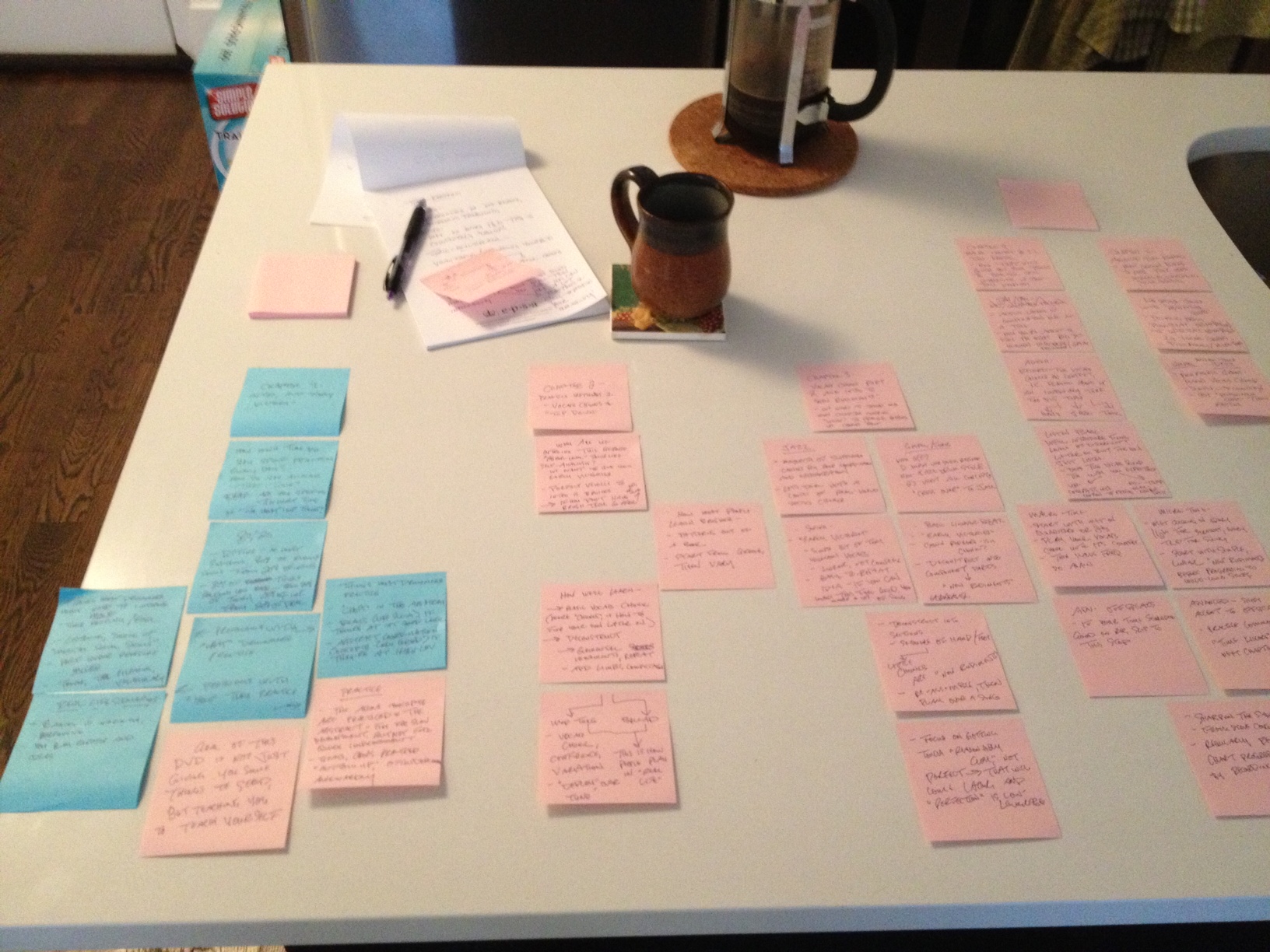
(photo below is the story board for my DVD)

photo(12)

Peering Over The Edge, and a Retreat to Basic Principles

“You have to throw a lot against the wall and see what sticks before you can do an 80/20 analysis.”

Time to explain the two things I’ve so far “thrown against the wall”, what I’ve learned, and why I’ve determined at least one more projectile aimed at said wall is probably warranted?

For the last three weeks, it’s been full speed ahead on two muse ideas. (“Muse”, for non-cultists, refers to an income-generating retail side-business requiring minimal upkeep.) The first I’ll describe in detail because it’s informational and utilizes a hard-won area of expertise. To describe the second, I’ll use the same generalities I’ve used with people I haven’t asked to sign non-disclosure agreements.

It’s the second muse, a specially shoe for a niche I belong to, that’s so far caused me the most headache. It’s also the most useful filter through which to examine the fundamental question of this blog – if it’s easy why isn’t everyone doing it? – and a related, secondary question that hit me today – what’s the difference between a muse and a traditional business.

Here, stage-by-stage, are answers to the first question:

-Inventing and testing a niche product idea is the easy part.

To review, the concept in Four Hour Work Week is once you have a couple of muse ideas, you use google Adwords – the sponsored search results you often see at the top of a search – to both test and prime the market for your ideas. Ideally, you would create ads for your products, create sites for those that test well (above a certain “click through rate”), then order product once you’re generating “orders” (in the form of people agreeing to the price, giving you their contact info, minus any credit card info – the collection of which under false pretenses is illegal – then clicking “buy now” and seeing a page telling them product is on back order) on your site. One month of negative cash flow while you recoup your investment, then onto profitability. Simple. Elegant.

In practice, of course, it’s hilariously more complicated. But explaining the distance between the theory and the practice is the purpose of this blog. Anyway, I went through some ridiculous “rough drafts” that google Adwords quickly disabused me of. Tim Ferriss is right that Adwords is a great tool to test and eliminate many a bad idea before settling on a couple of winners. I squealed with delight upon waking up and discovering that both of my ideas were generating healthy clicks, and the click-through rate (the percentage of people who see the ad who click through to the “website”) for the shoe was especially robust.

Two immediate issues.

-First, my average cost-per-click was around a dollar. That doesn’t seem bad – a dollar on advertising for a product that retails for many times that, until you remember standard conversion rates. (Google “px method”.) At 1.5% “click-through”, that means that 3 of every 200 people who see my ad actually click through to the site. So $200 for advertising, $300 in revenue assuming a $100 sticker price? Sound bad yet? Then remember that only 1-2% of the customers who visit your site actually *buy*. So for every 2000 people who see your ad, 30 visit your site, and fewer than 1 actually buy. $2000 for advertising, for maybe one sale of $100. As the scale of the failure of this first real-world test case dawned on me, I had to chuckle.

Anyway, back to the source…

Rereading the pertinent FHWW chapter, I discovered I’m supposed to aim for 1-2 *cents* cost-per-click. That would indeed make the model work – only $20 in advertising per $100 in revenue, with worst-case-scenario conversion rates. But none of the search terms I chose are anywhere *near* that cheap. They either had practically negligible search traffic, or averaged around a dollar per click. Then it hit me. FHWW was written in 2007. Is it possible that in the last 5 years adwords has gotten 50-100 times more expensive? Bingo. A little googling, and I found a chart detailing the inflation of Adwords costs. Further searching revealed a forum on fourhourworkweek.com where I discovered the phenomenon has a name: the “muse killer.”

Haha. So the low, loooooow hanging fruit has been picked. Jeez, iMAGine how easy it must have been back in 2007. I’ll speak further about PPC (“pay-per-click”) in later posts.

Alright – with the first bit of disillusionment out of the way, I accepted that I would have to use slower, more organic methods to generate web traffic. The good news about such methods (grouped under the term SEO, or “search engine optimization”, by the experts) is they’re usually more enduring, and the conversion rate of people who make some effort to seek you out because of word-of-mouth is much higher than that for those clicking on a sponsored search result on a whim.

All the same, allowing my business time to grow organically would put leave no margin for error with the cash flow. I would need to tweak my supply chain minutely.

-Which brings me to the second issue: how in blazes was I supposed to source this product?

The book presented two case studies – a man who ended up reselling French sailor shirts and a woman who created an instructional DVD. No problem with the second – I have plans to create an instructional DVD with a unique approach to teaching music – but the shirts were an exceptional example for a few reasons. First, it was a pre existing product, eliminating the need to find designers and manufacturers, pay for retooling, order 1500 units up front, etc. Second, contrary to the usual issue existing products face – fierce competition – it just-so-happened no one else in the entire nation was sourcing and retailing genuine French sailor shirts.

Which brings us to the crux of difference number two between FHWW and the real world: the Venn diagram between easily-sourced and low-competition is vanishingly small. Expensive to advertise or no, my shoe fulfills the second condition of the sailor shirts – low or no competition for a niche market within which interest in the product is high – but not the first. No pre-existing foreign manufacturing infrastructure I can tap with as little as a phone call.

Nope. I’ve gotta design, prototype and manufacture my baby from scratch. I’ll describe in greater detail my gantt/flow chart in the next post, but suffice it to say you can either spend a lot of money up front for somebody to hold your hand from design to 1,500 units in your garage, with no guarantee of sales, or you can ask a million questions, hire people one-at-time, and figure the bulk of things out on your own.

So I’m back to basic principles, and throwing more “against the wall.” I should remember that manufacturing my own invention is *supposed* to be labor intensive and complex, and that it’s just one of three suggestions – resell an existing product, license a product, or invent one. I’m already experimenting with two inventions – one physical, one informational – maybe I should add one more projectile to my wall-collage: reselling an existing product. My adventures with this third category, plus still more detail on my other two, next post.

20130226-230215.jpg

Four Hour Cheffing the Four Hour Workweek

I’ve been rabidly scribbling down bullet points from a Tim Ferriss interview with Derek Halpern that led me to investigate the meta learning of the Four Hour Chef.

Deconstruction

Selection

Sequencing

Stakes

Quite instinctively I’ve happened upon another –

Bootstrapping

You’d probably want to insert that one between Selection and Sequencing – DSBSS? (I’m choosing to omit description of DSSS from this post because you can read about it elsewhere/I want to focus on the parts directly germane to me.)

The issue I encountered with the muse is the chicken-egg conundrum of “I want to know enough that I won’t waste time/money when I actually start” and “I won’t know everything until I attempt it.” My single bit of advice is: Plan to Fail. That’s it. Plan To Fail at a lot of things, and you won’t be as dejected when your first few ideas don’t take (immediate) flight.

Set aside an amount of money you don’t mind “wasting”, say, $1000. Don’t get me wrong, you’re going to try to get the max out of every dollar, but you need to waste a few hundred experimenting with Adwords and registering domain names alone. I’ll describe in greater detail in another post, but I used Adwords to test two campaigns (and keyword tool to reject about 10 more), and learned plenty to justify my $280 (less than the tuition for a seminar).

Before I lose you, the most important part: Bootstrapping. “Sharpen the Saw,” as Steve Covey says.

You do want to do as much research as possible before you begin – I recommend memorizing the muse-related chapters in FHWW, reading all the muse case studies on Tim’s blog, then checking out Pat Flynn’s, Derek Halpern’s, and Dean Dwyer’s podcasts for more recent, real-world applications – but eventually you’ll have to begin, and that’s where you’ll make your “college try” at a muse or two, and enjoy some exciting successes (“holy shit my click-through rate is through the roof!”), and some failures (“why hasn’t a single person from Elance gotten back to me?!?”).

But here’s the most important part – the “force multiplier”. Now that you’re into some things, and especially when you hit “sticking points”, go back and reread/re-listen-to some of the material you’ve been ruminating on, and just watch all the little details that pop out at you now, that you didn’t notice the first time, just as once you have a kid you suddenly notice the minutiae of disposable diaper brands, or once you’ve purchased a minivan you suddenly notice absurd levels of detail in others’…[ugggh]…minivans.

To play fair/be abundance-minded, here are two details that popped out at me upon “re-upping” some of my source content-

1) “You have to throw a lot of things at the wall and see what sticks before you can do 80/20 analysis,” which I take to mean be zen about your first few stabs failing or getting stuck and be open minded to the possibility that the ideas themselves weren’t a great fit.

2) “Give 5% of the company to a couple of clutch advisers that will give you 1-2 hours per week to review strategy, make introductions, and help drive sales. You CAN NOT do it all by yourself.” In identifying common failure points and people that press past them, one recurring theme is a network of business folks willing to help you. This proved especially prescient after one of my muses got bogged down at the sourcing/prototype stage.

Ok, I’ll be back soon to tell you what my muses are/were/will be (to the degree I can;), what problems I encountered, and how I (hopefully) solved them.minivan

Pilot

As I write this on the F train, bound for Broadway Lafayette, and eventually for my office, I can be pretty confident that even if someone looked over my shoulder and saw the subject line, odds are they wouldn’t know what I was talking about. In fact it’s a fair bet the folks on this car wouldn’t even identify the origins of the “breaking” part.Begin at the middle? What better way to 80/20 my writing than to do it via iPhone during the minutes I’m stuck on the train anyway. I’ve already used this method to push through writer’s block on a couple of projects. Caveat – I underestimated my propensity for motion sickness.I’m apparently a late convert to the Four Hour Work Week school, but I’ve already answered my first question – if it’s so easy why doesn’t everybody do it? – to my satisfaction. Two reasons- 1) it’s not easy and the devil is in the details, 2) unless they’re desperate enough most people will choose mild unhappiness/boredom and stability over a shot at controlling their lives in exchange for slightly greater risk. I actually have zero data to back up the second part. But that’s been my anecdotal experience.

Here are the broad strokes – it took me six years to become frustrated enough with my job to want to leave and another year to know what the hell else to do. In a way all the things that make my situation a shitty one to imagine spending your life in also make it an ideal one for trying Tim Ferriss’ life experiments on myself – the dead end job where no one notices a thing I do pays relatively well, especially on a per-hour basis because the aforementioned inattention to my activities allows flexibility and easy escape. Ten years spent at the whetstone of my stalled music, writing, and business ambitions has honed me into a pretty decent content-creator. The fact that my skills don’t translate well on a resume could be viewed as a blessing in that it forces me not to settle for another “easy” day job that makes me want to die in the fetal position.

So this blog is intended to catalog my trials and tribulations – a meta, Meta muse. One in which I can feel completely free to tell you that I’m inserting key phrases like “Tim ferriss muse ideas” and “Tim ferriss muse bullshit,” in hopes potential readers might be googling those phrases. And by God by the time this experiment is complete this blog should prove a pretty decent resource to a reader with those questions on his mind. My skepticism about Tim probably mirrors most people’s – a Princeton grad who taught himself Japanese in six months, won the national Chinese kickboxing championship, and just happened to have the business acumen to turn his second startup – Brain Quicken/Body Quick – into a million-dollar baby before spinning it off to a private equity firm – understandably elicits cries of “sampling bias” when he claims to be a stand-in for the Everyman. (Yes, I know he’s received success stories from readers – I’m a mild skeptic, not a disbeliever.) But, dear reader, if there was ever a case study in “if he can do so can I,” I am he.

So let’s start with what I know – Tim preaches creating an automated income locus called a Muse. After weeks of reading and rereading FHWW, I believe I finally understand the key components – a market you’re a part of, specific enough to escape competition with multinationals (for whom selling to your niche is presumably not worth their time), a product simple enough to source in small quantities, cheap enough that a 10x markup will sell, and lending itself to either drop shipping or easy forwarding to a fulfillment center, and an advertising/market testing platform cheap enough that even a .1% impression to conversion rate is still a manageable fraction of the per-customer revenue.

Starting to notice a few layers of condition building up? So am I. And I can tell you about them, having tested two Muses from Inception to Sticking Point. Stick with me through the next few posts as I chronicle my ideas, what I did with them, where I hit “walls,” and, hopefully, what I did to break through them. I’ll be as specific as I can without giving away ideas I’m asking people to sign non-disclosure agreements about, and hopefully it will be mutually beneficial: therapy/rumination for me, Real World (2013) case study for you.photo(7)